


CAC49 / New and revised science-based standards now added to the Codex Alimentarius
.jpg?sfvrsn=9585ddcd_12)
The 49th session of the Codex Alimentarius Commission (CAC) has concluded with adoption of some key texts or revisions of texts, the election of Spain as the new host country to the Codex Committee on Fish and Fishery Products (CCFFP), and discussion and agreement on new work and the report of the implementation of the Codex Alimentarius Commission strategic plan 2020–2025.
Upon report adoption, there were short speeches of appreciation for the hard work done by colleagues in WHO, FAO and in the Codex Secretariat. FAO’s Chief Scientist gave closing remarks in which he underlined FAO’s commitment to science and its vital role for Codex. “As I see it,” he said, “Codex is an exemplar of the fundamental role that science must play in global decision making. It provides an unarguable, neutral and robust reference for the harmonized and rules-based trade in food that is so fundamental to food security, public health, economies and livelihoods worldwide.” The Chief Scientist acknowledged the discussions during the week, on the challenges faced by the Commission regarding provision of data to inform Codex work, resource constraints limiting scientific capacity, and related topics. “While these challenges exist, and solutions will not be instant,” he continued, “I can reassure you of FAOs commitment to science and to the food safety scientific advice programme.” The Chief Scientist went on to describe the positivity that surrounds the ongoing artificial intelligence (AI) revolution and recognized that this had also emerged during plenary debates. “Artificial Intelligence offers significant opportunities to strengthen scientific advice, improve evidence synthesis, enhance risk analysis and support decision-making,” he pointed out, but cautioned: “However, I believe we must proceed carefully and judiciously.” He concluded by acknowledging that AI can be a tool, but that human intervention in Codex standards development and decision-making continues to rely on the “commitment, collaboration and global outlook” of Codex Members and Observers.
The Codex Alimentarius Commission Chairperson, Allan Azegele, then closed the session, saying: “I wish to express my sincere appreciation to each and every one of you for your dedication, professionalism, and constructive engagement throughout our deliberations over the six sessions of this Commission.” The Chairperson underlined the consensual nature of Codex work. “We have once again demonstrated that Codex is at its strongest when we walk together through respectful dialogue and a willingness to find common ground,” he said. “We have advanced our shared mission of protecting consumer health and ensuring fair practices in the food trade. Every decision we have taken represents another step towards safer food, stronger food control systems, and confidence in international trade.” He thanked Members and Observers for their “expertise, patience, and commitment”.
CAC49 has adopted, among other things, the Standard for spices in the form of dried fruits and berries - large cardamom, and the Standard for spices derived from dried or dehydrated fruits and berries – vanilla, elaborated in the Codex Committee on Spices and Culinary Herbs (CCSCH). Revisions of the Guidelines for the control of Campylobacter and Salmonella in chicken meat (CXG 78-2011) and of the Guidelines on the application of general principles of food hygiene to the control of Listeria monocytogenes in foods (CXG 61-2007), which were elaborated in the Codex Committee on Food Hygiene (CCFH) were also adopted. The Standard for bakers’ yeast has become the first ever commodity standard elaborated by the Codex Committee on Food Additives (CCFA), which also saw revisions to the General standard for food additives (GSFA, CXS 192-1995) adopted. Groundbreaking guidelines on the use of precautionary allergen labelling will now be annexed to the General standard for the labelling of pre-packaged foods (CXS 1-1985) of the Codex Committee on Food Labelling (CCFL), which also saw its Guidelines on application of food labelling provisions in emergencies adopted.
Read more
Related content
A committee of shared purpose: Sally Hoffer on the evolution of CCCF
Dr Sally Hoffer has chaired the Codex Committee on Contaminants in Food since 2021. CCCF19 will be her last as Chairperson, as she hands over to her successor, Dr Susanne Sutterlin. We spoke with Dr Hoffer...
Interconnectedness is a key factor in inspection and certification work, as Committee meets for 28th Session
The 28th Session of the Codex Committee on Food Import and Export Inspection and Certification Systems (CCFICS) opened in a hybrid format in Perth, Australia, on 12 October, with opening remarks from the...
Have you met the Fishmonger?
Codex standards are science-based and developed with input from Codex Members and Observers who bring their experience and expertise to the standard development process. Implementation of Codex standards...
Discussions by correspondence on the proposed standard for pasteurized camel milk get under way
The newly reactivated Codex Committee on Milk and Milk Products (CCMMP) has started its 11th session, with a single agenda item, with the aim of developing a standard for pasteurized liquid camel milk....
Meet the Chairperson of the Codex Committee on Milk and Milk Products
The Codex Committee on Milk and Milk Products (CCMMP) will work by correspondence 29 September–29 October 2026 to discuss the proposed draft standard for pasteurized liquid camel milk. In anticipation...
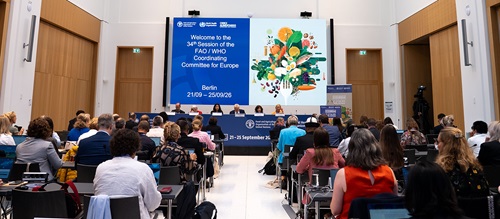
Risk communication, nutrition and food safety shape discussions at CCEURO34
The 34th Session of the FAO/WHO Coordinating Committee for Europe (CCEURO) has concluded in Berlin after a week of intensive discussion on topics relevant to food safety and Codex work in the region. Germany’s...
-jpg.tmb-thb5x4.jpeg?Culture=en&sfvrsn=4d06e677_5)
International standards can help turn the One Health principle into actions
At FAO’s Global Conference for Actions on One Health in Agrifood Systems, which is taking place in Rome, Italy 21–23 September 2026, included a session, Tuesday, on the role of international standards...
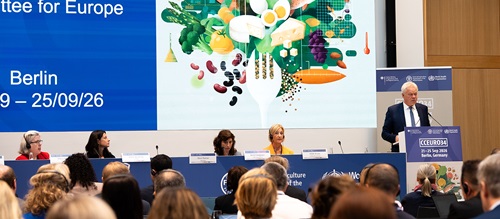
Federal Minister of Agriculture, Food and Regional Identity of Germany opens CCEURO34
The 34th Session of the FAO/WHO Coordinating Committee for Europe (CCEURO34) has opened. Alois Rainer, Federal Minister of Agriculture, Food and Regional Identity of Germany, welcomed the delegates in...
-jpg.tmb-thb5x4.jpeg?Culture=en&sfvrsn=6fd562_5)
57th committee meeting scrutinizes pesticides for residue safety and receives updates on database modernization
The 57th Session of the Codex Committee on Pesticide Residues concluded in Beijing, China. During the one-week session, CCPR considered several compounds evaluated at the 2025 JMPR Meeting and advanced...