


Have you met the Fishmonger?
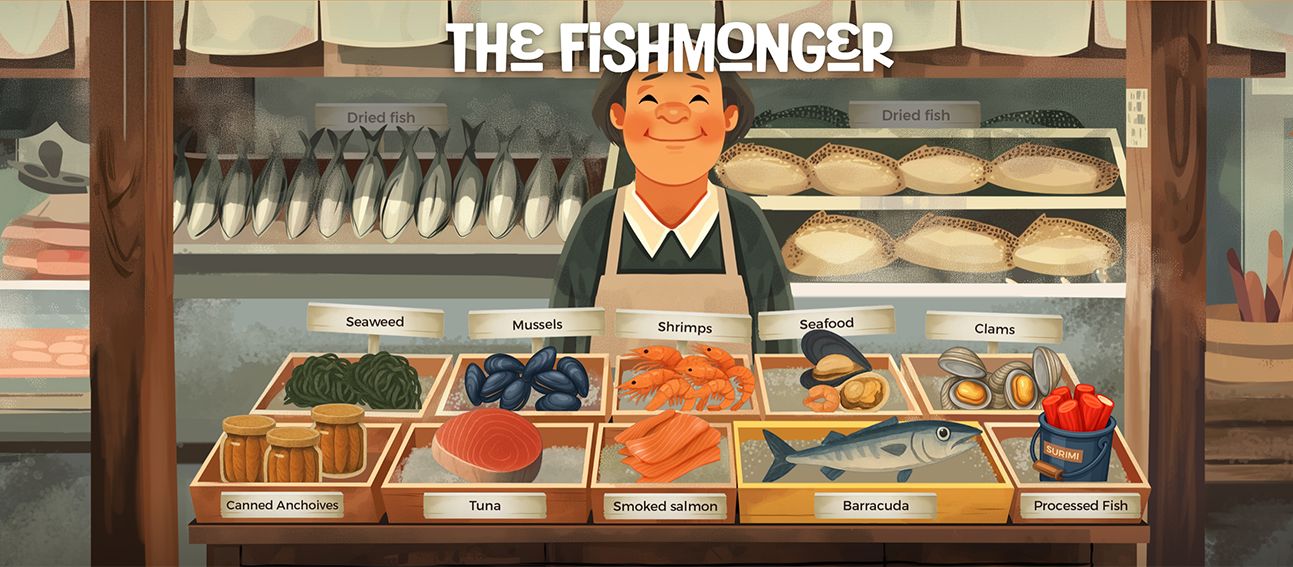
Codex standards are science-based and developed with input from Codex Members and Observers who bring their experience and expertise to the standard development process. Implementation of Codex standards helps ensure food is safe.
This is the message of the Codex and FAO Fishmonger, who is now online! She brings food safety to life by showing how international standards support safe food in everyday settings. From shellfish and tuna to seaweed and smoked salmon, users of this online feature can explore a range of food safety challenges and learn how science-based standards help prevent risks before products reach consumers.
The fishmonger stall, through 10 different products allows users to explore different food safety hazards associated with these products, and how the application of Codex standards contributes to ensuring these products are safe to eat.
With the help of FAO experts from different divisions, and food standards officers from the Codex Secretariat, this innovative online feature describes different hazards and explores the science and risk assessments that inform food safety standards. Crucially, it also underlines the One FAO ethos and multisectoral approach needed to understand and address the complexities of today’s agrifood systems.
“I believe this initiative enhances understanding of the Codex standard-setting process and the role that FAO and WHO play in supporting it through the FAO/WHO Food Safety Scientific Advice Programme and ad hoc expert meetings. These expert bodies generate scientific evidence that informs the work of the various Codex committees, both commodity-specific and horizontal, enabling the development of important standards, codes of practice, guidance documents, and other texts. These outputs help governments and the private sector protect consumers while facilitating trade through the harmonization of requirements,” comments Esther Garrido Gamarro, Fishery Officer at FAO.
This is an important message, too, for the Codex community, which has recognized in its strategic planning the interconnectivity of Codex texts with science, international organizations and those working in the food chain, like the Fishmonger herself. “Codex texts only achieve their intended impact when they are implemented,” comments Codex Secretary, Sarah Cahill. “They are implemented because governments and food businesses trust the science that underpins them, and also because they provide the common basis for the safety of food in trade. Codex does not and cannot work in a silo, but its work is interwoven with that of public and private sectors globally.”
Read more
Related content
A committee of shared purpose: Sally Hoffer on the evolution of CCCF
Dr Sally Hoffer has chaired the Codex Committee on Contaminants in Food since 2021. CCCF19 will be her last as Chairperson, as she hands over to her successor, Dr Susanne Sutterlin. We spoke with Dr Hoffer...
Interconnectedness is a key factor in inspection and certification work, as Committee meets for 28th Session
The 28th Session of the Codex Committee on Food Import and Export Inspection and Certification Systems (CCFICS) opened in a hybrid format in Perth, Australia, on 12 October, with opening remarks from the...
Discussions by correspondence on the proposed standard for pasteurized camel milk get under way
The newly reactivated Codex Committee on Milk and Milk Products (CCMMP) has started its 11th session, with a single agenda item, with the aim of developing a standard for pasteurized liquid camel milk....
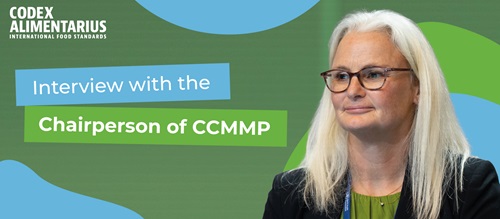
Meet the Chairperson of the Codex Committee on Milk and Milk Products
The Codex Committee on Milk and Milk Products (CCMMP) will work by correspondence 29 September–29 October 2026 to discuss the proposed draft standard for pasteurized liquid camel milk. In anticipation...
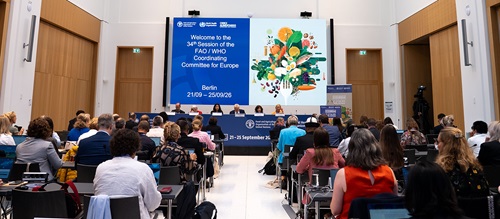
Risk communication, nutrition and food safety shape discussions at CCEURO34
The 34th Session of the FAO/WHO Coordinating Committee for Europe (CCEURO) has concluded in Berlin after a week of intensive discussion on topics relevant to food safety and Codex work in the region. Germany’s...
-jpg.tmb-thb5x4.jpeg?Culture=en&sfvrsn=4d06e677_5)
International standards can help turn the One Health principle into actions
At FAO’s Global Conference for Actions on One Health in Agrifood Systems, which is taking place in Rome, Italy 21–23 September 2026, included a session, Tuesday, on the role of international standards...
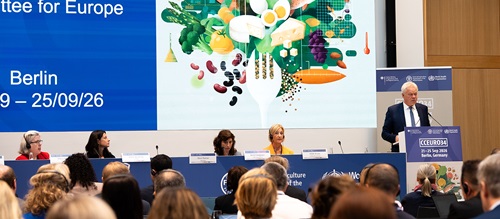
Federal Minister of Agriculture, Food and Regional Identity of Germany opens CCEURO34
The 34th Session of the FAO/WHO Coordinating Committee for Europe (CCEURO34) has opened. Alois Rainer, Federal Minister of Agriculture, Food and Regional Identity of Germany, welcomed the delegates in...
-jpg.tmb-thb5x4.jpeg?Culture=en&sfvrsn=6fd562_5)
57th committee meeting scrutinizes pesticides for residue safety and receives updates on database modernization
The 57th Session of the Codex Committee on Pesticide Residues concluded in Beijing, China. During the one-week session, CCPR considered several compounds evaluated at the 2025 JMPR Meeting and advanced...
-jpg.tmb-thb5x4.jpeg?Culture=en&sfvrsn=12ace103_5)
At 60, a forward-looking pesticides committee continues making progress
The 57th Session of the Codex Committee on Pesticide Residues (CCPR) has opened in Beijing, China, 60 years after its first meeting in the Kingdom of the Netherlands in 1966. DUAN Lifang will preside over the Session for the first time as Chairperson of CCPR.