


Interconnectedness is a key factor in inspection and certification work, as Committee meets for 28th Session
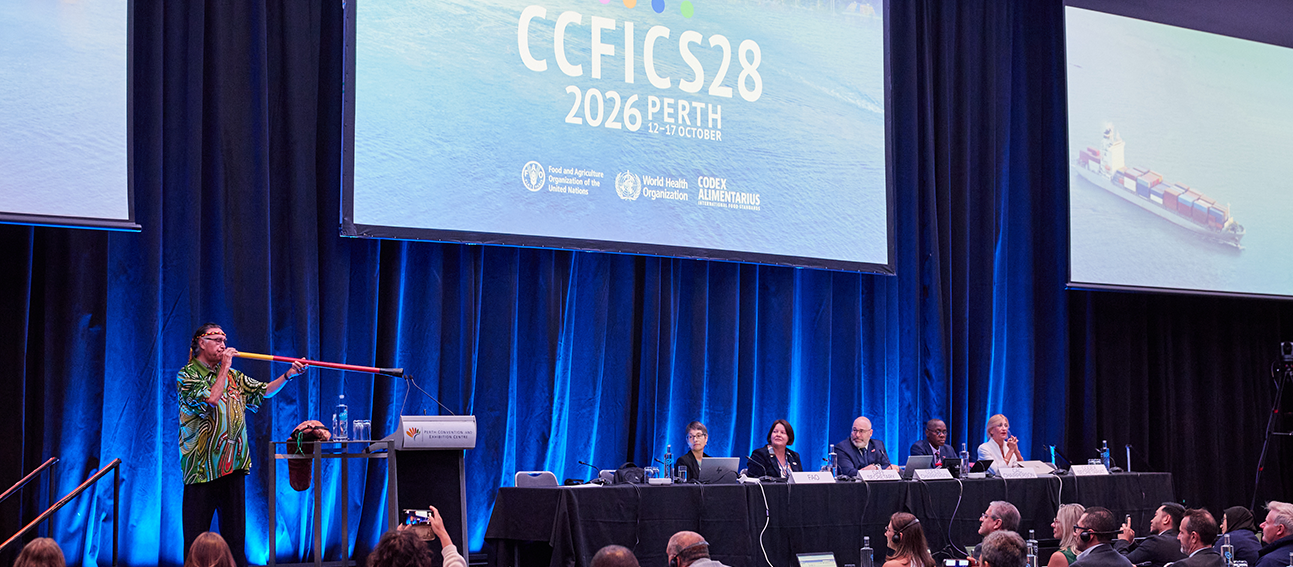
The 28th Session of the Codex Committee on Food Import and Export Inspection and Certification Systems (CCFICS) opened in a hybrid format in Perth, Australia, on 12 October, with opening remarks from the Minister for Agriculture, Fisheries and Forestry, the honourable Julie Collins MP, Victoria Anderson, Secretary to the Department of Agriculture, Fisheries and Forestry, the Codex Alimentarius Commission Chairperson, the Codex Secretary and representatives of FAO and WHO. These all highlighted the role of CCFICS in developing texts that express the connectedness of countries and diverse systems, cultures and people in an internationally agreed global framework for the trade in food.
Before they spoke, however, the Committee was welcomed by James Webb, from the Noongar tribe, the traditional custodians of the land on which they were meeting, Perth. He reminded delegates of the connectedness of people to land and of the need to recognize and respect the flora and fauna of the world around them. “We really do have to look after land; we really do have to look after people,” he urged.
Julie Collins acknowledged the shared responsibility of food safety and security systems and their importance to agricultural industries and to international trade. Setting the tone for subsequent contributions, the Minister spoke to the continued relevance of CCFICS, especially considering “emerging science, environmental changes and geopolitical challenges”. In her welcome remarks, Victoria Anderson highlighted the different overarching topics on the CCFICS28 meeting agenda: equivalence, food fraud, traceability and digitalization, “and what they mean for modern regulation and food security”. In expanding on each of these topics, the Secretary described how they, too, interconnect and how “each item on your CCFICS agenda this week represents an opportunity to support better regulation strengthen confidence and enable more predictable trade.” She highlighted the fundamental importance of these topics to food security itself and, referring to the current challenges already outlined by the Minister, described how the vulnerability of national and global food systems has been brought into sharp focus in Australia itself, which is typically considered food secure. “I think recent times have really taught us that we have more to think about than just the export supply chain or the production supply chain, the input supply chain - it's all increasingly interconnected and the vulnerabilities of that we've seen recently have really opened our eyes to the issues that many of you have been facing for many years,” she said, continuing: “we rely on strong international institutions, science-based decisions and a rules-based trading system that enables countries to solve shared problems together.”
Referring to the Codex Alimentarius Commission strategic plan 2026–2031, Allan Azegele, the Codex Alimentarius Commission Chairperson (CAC), pointed out that “the plan emphasizes the importance of responding to Members’ needs, developing standards and guidelines in a timely transparent and inclusive manner and strengthening collaboration and consensus building”. In that regard, the CAC Chairperson focused particularly on one agenda item that is very close to finalization: “food fraud poses significant challenges to the integrity of food supply chains consumer confidence and fair trade,” he said. He concluded, returning to diversity and connectedness: “the strength of Codex lies in our ability to transform diverse perspectives and technical expertise into international agreed outcomes that benefits all. I encourage you to approach our deliberations with openness collaboration and shared sense of responsibility.”
Sarah Cahill, Codex Secretary, joined virtually and spoke of the way in which CCFICS work provides connectivity within the Codex system itself: “the work of CCFICS provides a framework that contributes directly to the implementation, credibility and effectiveness of the broader Codex Alimentarius,” she said, continuing: “CCFICS texts can support the implementation of standards developed elsewhere in Codex as committees consider issues such as food fraud and traceability. In particular I think there is a recognition that solutions to these issues rarely sit within one single committee or one single text.” She asked delegates, then, to consider “exploring how your guidance can support and be better recognized in the work across the wider Codex Alimentarius Commission.”
Catherine Bessy, on behalf of FAO outlined how CCFICS work is fundamental to FAO’s capacity development: “across all regions, countries continue to seek support in strengthening national food control systems, improving regulatory frameworks, enhancing official controls, implementing risk-based approaches, and adopting digital tools to support these topics - and this Committee provides an important normative foundation for this work.” For WHO, Simone Moraes Raszl said: “effective, transparent and science-based inspection and certification systems must protect customers, build confidence between trading partners and support fair practices in food trade. For WHO, protecting consumer health must remain at the centre of this work. Strong national food control systems, effective cooperation between competent authorities and timely access to reliable information are essential to prevent and manage food safety risks across borders.”
Read more
Related content
A committee of shared purpose: Sally Hoffer on the evolution of CCCF
Dr Sally Hoffer has chaired the Codex Committee on Contaminants in Food since 2021. CCCF19 will be her last as Chairperson, as she hands over to her successor, Dr Susanne Sutterlin. We spoke with Dr Hoffer...
Have you met the Fishmonger?
Codex standards are science-based and developed with input from Codex Members and Observers who bring their experience and expertise to the standard development process. Implementation of Codex standards...
Discussions by correspondence on the proposed standard for pasteurized camel milk get under way
The newly reactivated Codex Committee on Milk and Milk Products (CCMMP) has started its 11th session, with a single agenda item, with the aim of developing a standard for pasteurized liquid camel milk....
Meet the Chairperson of the Codex Committee on Milk and Milk Products
The Codex Committee on Milk and Milk Products (CCMMP) will work by correspondence 29 September–29 October 2026 to discuss the proposed draft standard for pasteurized liquid camel milk. In anticipation...
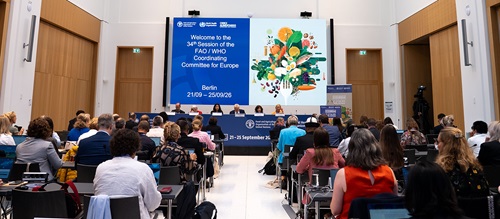
Risk communication, nutrition and food safety shape discussions at CCEURO34
The 34th Session of the FAO/WHO Coordinating Committee for Europe (CCEURO) has concluded in Berlin after a week of intensive discussion on topics relevant to food safety and Codex work in the region. Germany’s...
-jpg.tmb-thb5x4.jpeg?Culture=en&sfvrsn=4d06e677_5)
International standards can help turn the One Health principle into actions
At FAO’s Global Conference for Actions on One Health in Agrifood Systems, which is taking place in Rome, Italy 21–23 September 2026, included a session, Tuesday, on the role of international standards...
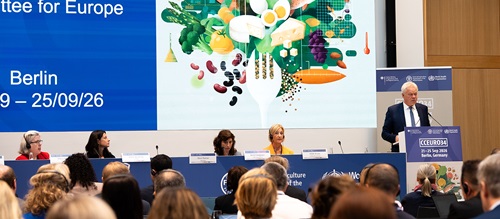
Federal Minister of Agriculture, Food and Regional Identity of Germany opens CCEURO34
The 34th Session of the FAO/WHO Coordinating Committee for Europe (CCEURO34) has opened. Alois Rainer, Federal Minister of Agriculture, Food and Regional Identity of Germany, welcomed the delegates in...
-jpg.tmb-thb5x4.jpeg?Culture=en&sfvrsn=6fd562_5)
57th committee meeting scrutinizes pesticides for residue safety and receives updates on database modernization
The 57th Session of the Codex Committee on Pesticide Residues concluded in Beijing, China. During the one-week session, CCPR considered several compounds evaluated at the 2025 JMPR Meeting and advanced...
-jpg.tmb-thb5x4.jpeg?Culture=en&sfvrsn=12ace103_5)
At 60, a forward-looking pesticides committee continues making progress
The 57th Session of the Codex Committee on Pesticide Residues (CCPR) has opened in Beijing, China, 60 years after its first meeting in the Kingdom of the Netherlands in 1966. DUAN Lifang will preside over the Session for the first time as Chairperson of CCPR.