


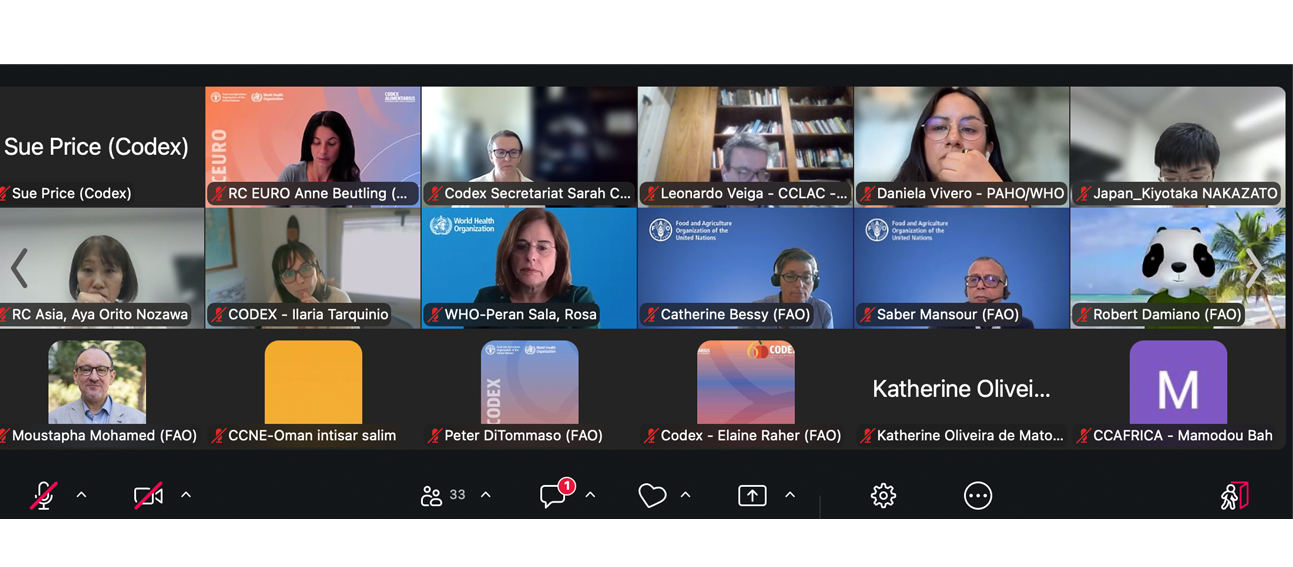
The Codex coordinators met with representatives
of the Codex Secretariat, FAO and WHO, to prepare for a new cycle of FAO/WHO coordinating
committee meetings, with six regional sessions scheduled between September 2026
and December 2027. The virtual meeting, moderated by Hilde Kruse, Senior Food
Standards Officer in the Codex Secretariat, brought together 34 participants
from across the regions and focused on strengthening coordination,
communication, capacity development and practical support for the upcoming
sessions.
Codex Secretary, Sarah Cahill,
highlighted the important role of the coordinating committees within the Codex
system as they provide a forum for identifying regional food safety and
quality concerns, exchanging experiences, strengthening coordination and
bringing regional perspectives into the global standard-setting process. The
committees can also provide an entry point for newer Codex Members to become
familiar with the system and participate more effectively in Codex.
A central theme of the discussion was
the broad role of coordinators. Participants stressed that coordinators do more
than host and chair committee meetings: they maintain contact with Members,
identify priorities and capacity gaps, facilitate exchanges, connect countries
with technical expertise and represent regional positions in Codex meetings and
sessions of the Executive Committee. Anne Beutling, representing the Coordinator
for Europe, described regular informal meetings, targeted communication, and
peer-to-peer exchanges as useful tools for maintaining engagement between
formal sessions.
Several coordinators pointed to persistent challenges, including limited resources, staff turnover and the difficulty of maintaining institutional knowledge. FAO and WHO representatives highlighted that capacity development should go beyond training individuals and instead strengthen institutions, procedures and policy and legal frameworks so that knowledge can be retained when personnel change.
The meeting addressed the importance of
the use of regional “mini-teams” comprising the coordinator, and dedicated FAO
and WHO personnel and Codex Secretariat staff. These teams are intended to
provide continuity, harmonize preparations and tailor meeting agendas and
keynote discussions to regional priorities. Participants called for further collaboration
using these “mini-teams”.
The next meeting in the cycle, CCEURO34,
is scheduled for 21–25 September in Berlin, followed by CCLAC24 in Montevideo, Uruguay
on 23-27 November. In 2027, CCNASWP will meet in the Cook Islands in February,
CCAFRICA in The Gambia in March, CCASIA in Japan from 29 November to 3 December,
and CCNE in Oman on 5-9 December.
Organizational planning was another
priority. The Codex Secretariat emphasized early preparation of host-country
agreements, budgets, accommodation, interpretation, technology and other
logistical requirements. Participants agreed that timely preparatory work and
sustained communication would be essential to delivering the six upcoming meetings
successfully.
The session concluded with the Secretariat committing to continued regular exchanges and support for the regional mini-teams as preparations advance.
Read more
Related content
CCNE Highlights Inter-Regional Codex Cooperation at the Third AFRAF Meeting
Dr Intisar Al-Gharibi (Sultanate of Oman), Chairperson of the FAO/WHO Coordinating Committee for the Near East (CCNE), contributed to the Third African Food Regulatory Authorities Forum (AFRAF), held in...
EAC Partner States convene for the 20th EAC Codex Forum meeting in Kigali to advance food safety and Codex matters in the region
By Lilian Gabriel Peter, EAC Codex Forum Chairperson and Ms Niyonshuti Rosine, EAC Codex Forum SecretaryFrom 6 to 9 October 2026, the East African Community (EAC) Secretariat convened the 20th EAC Codex...
Regional workshop equips countries to generate the science behind Codex pesticide MRLs
How can countries in Asia make sure their most important crops, especially tropical fruits and vegetables, are covered by Codex standards? That question drove a lively and highly interactive Regional Workshop...
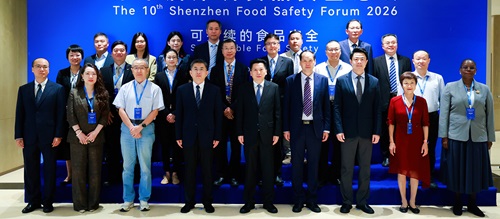
Codex strategic plan takes centre stage at the 2026 Shenzhen Food Safety Forum
The 2026 Shenzhen Food Safety Forum took place in Shenzhen (China) on 15 September 2026 under the theme of “Sustainable Food Safety”, in response to the Codex Alimentarius Commission strategic plan 2026–2031...
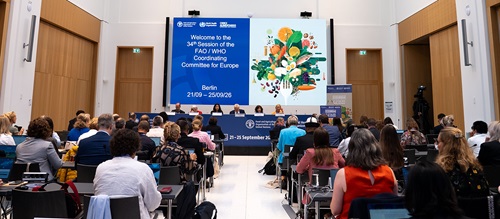
Risk communication, nutrition and food safety shape discussions at CCEURO34
The 34th Session of the FAO/WHO Coordinating Committee for Europe (CCEURO) has concluded in Berlin after a week of intensive discussion on topics relevant to food safety and Codex work in the region. Germany’s...
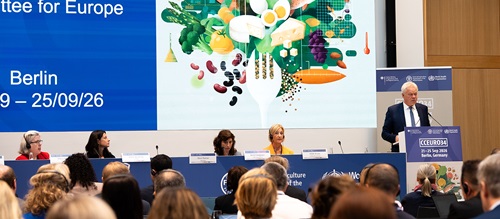
Federal Minister of Agriculture, Food and Regional Identity of Germany opens CCEURO34
The 34th Session of the FAO/WHO Coordinating Committee for Europe (CCEURO34) has opened. Alois Rainer, Federal Minister of Agriculture, Food and Regional Identity of Germany, welcomed the delegates in...
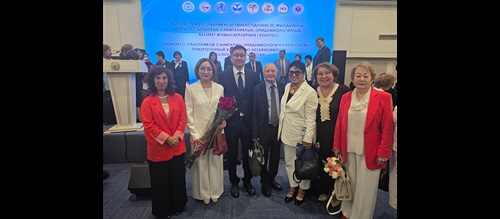
The first Congress of the Sanitary-Epidemiological Service took place in Kazakhstan
On 15 September 2026, the 1st Congress of Sanitary-Epidemiological Service Workers of the Republic of Kazakhstan took place in Almaty, and was dedicated to their professional holiday and the 35th anniversary...
-jpeg.tmb-thb5x4.jpeg?Culture=en&sfvrsn=9b7f8bef_6)
CCNE strengthens regional coordination ahead of CAC49
As part of their continued commitment to strengthening regional coordination and enhancing participation in Codex activities, the FAO/WHO Coordinating Committee for the Near East (CCNE) and the Arab Industrial...
High-level advocacy event strengthens Africa’s commitment to food safety and Codex participation
by the CCP of The Gambia On the margins of the 49th Session of the Codex Alimentarius Commission (CAC49), The Gambia, in its capacity as Coordinator of the FAO/WHO Coordinating Committee for Africa (CCAFRICA),...