


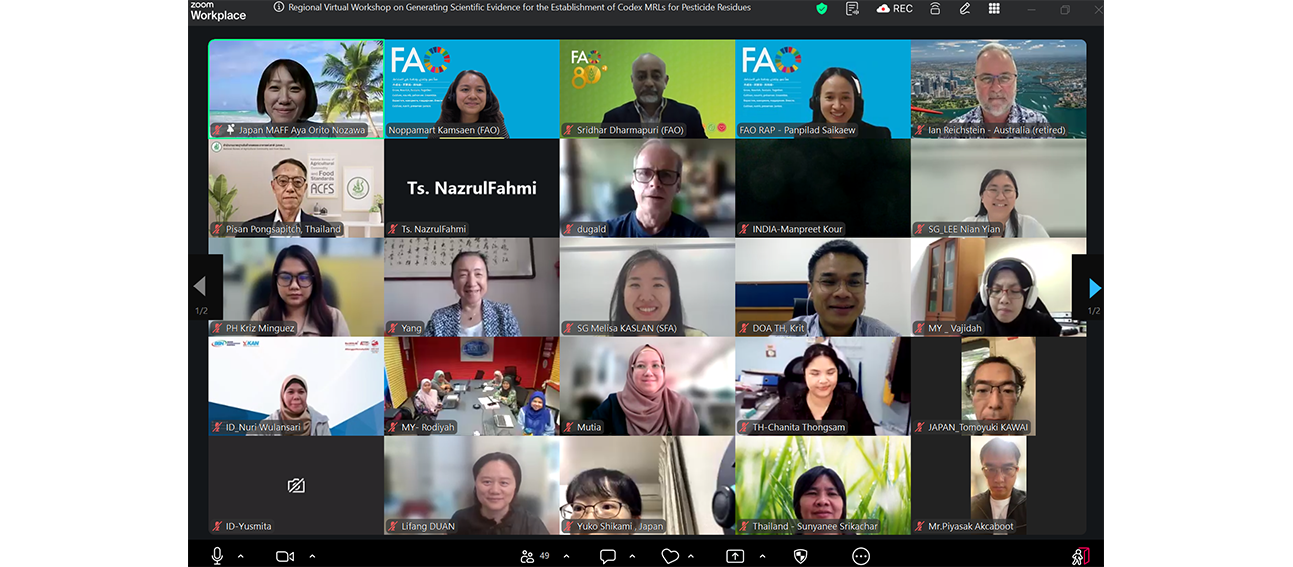
How can countries in Asia make sure their most important crops, especially tropical fruits and vegetables, are covered by Codex standards? That question drove a lively and highly interactive Regional Workshop on Generating Scientific Evidence for the Establishment of Codex Maximum Residue Limits (MRLs) for Pesticide Residues, held virtually on 23 September 2026.
Building on the momentum of the 57th Session of the Codex Committee on Pesticide Residues (CCPR57), the workshop was organized by the FAO Regional Office for Asia and the Pacific (FAO RAP) under the regional project "Strengthen Capacity on Data Generation and Utilization for Elaboration of Science-Based Food Safety Standards for ASEAN Countries" (GCP/RAS/418/JPN), in collaboration with the Ministry of Agriculture, Forestry and Fisheries of Japan in its role as Regional Coordinator for Asia. Opening the workshop to all interested Members of the FAO/WHO Coordinating Committee for Asia (CCASIA) broadened its reach and encouraged exchange across the region.
The response was strong: 58 participants from 11 countries joined, including government officials and technical experts working on supervised residue trials, scientific evaluation and MRL development. Some countries in the region still lack Codex MRLs for commodities of national interest and face real challenges in generating the data needed to support them.
Sridhar Dharmapuri, Senior Food Safety and Nutrition Officer, FAO RAP, welcomed participants, followed by opening remarks from Aya Orito-Nozawa, Chair of the FAO/WHO Coordinating Committee for Asia (CCASIA), who underscored the importance of Asian countries contributing scientific evidence to international standard-setting.
From there, the programme moved quickly from the "why" to the "how." Pisan Pongsapitch, former Secretary General of Thailand's National Bureau of Agricultural Commodities and Food Standards, set the scene by showing how science underpins both consumer protection and fair trade. His message to the region was clear: without sufficient evidence, nationally and regionally important commodities may remain without suitable Codex MRLs.
Participants then got an insider's view of the Joint FAO/WHO Meeting on Pesticide Residues (JMPR) process. YongZhen Yang, former JMPR Secretariat, walked them through the key scientific evidence required by the Joint FAO/WHO Meeting on Pesticide Residues (JMPR), the submission and evaluation process, and the common reasons JMPR may be unable to recommend an MRL. JMPR expert Dugald Maclachlan built on this with a practical look at frequent gaps in data submissions and how to avoid them.
Ian Reichstein, retired former Director of Australia's National Residue Survey and Australian delegation leader to CCPR, turned the focus to planning, sharing guidance on how countries can strategically organize national evidence generation for future Codex MRLs. Mohammad Nazrul Fahmi Abdul Rahim, Deputy Director of Pesticides Control and Fertilizer Division, Department of Agriculture, Malaysia, then brought it all to life with Malaysia's own experience of planning and generating data to support Codex MRLs. Each session was followed by active discussion, with participants raising questions drawn from their own national experience.
The workshop also introduced the FAO practical handbook on Proposing new compounds and additional pesticide/commodity combinations to establish Codex maximum residue limits, a hands-on reference for national planning, data generation and future submissions to JMPR and CCPR.
Participants left with both new knowledge and fresh motivation. "The workshop provided valuable insights into the scientific evidence and data requirements for JMPR evaluation and highlighted the importance of strengthening regional capacity to generate high-quality residue data. Greater collaboration among Asian countries in generating and sharing scientific evidence could help address gaps in Codex MRLs, particularly for tropical fruits and vegetables of regional importance," said Mohd Amir Paray from India.
Nuri Wulansari from Indonesia agreed: "Participating in this virtual workshop provided a comprehensive understanding of the process for establishing Codex MRLs, highlighting the critical role of scientific evidence. It offered practical insights into the key data required for JMPR evaluation, as well as strategies to strengthen national data submissions to JMPR and CCPR."
The workshop marks an important step toward stronger participation by Asian countries in Codex pesticide work, and it opens the door to closer regional collaboration.
Read more
Related content
Codex strategic plan takes centre stage at the 2026 Shenzhen Food Safety Forum
The 2026 Shenzhen Food Safety Forum took place in Shenzhen (China) on 15 September 2026 under the theme of “Sustainable Food Safety”, in response to the Codex Alimentarius Commission strategic plan 2026–2031...
-jpg.tmb-thb5x4.jpeg?Culture=en&sfvrsn=6fd562_5)
57th committee meeting scrutinizes pesticides for residue safety and receives updates on database modernization
The 57th Session of the Codex Committee on Pesticide Residues concluded in Beijing, China. During the one-week session, CCPR considered several compounds evaluated at the 2025 JMPR Meeting and advanced...
-jpg.tmb-thb5x4.jpeg?Culture=en&sfvrsn=12ace103_5)
At 60, a forward-looking pesticides committee continues making progress
The 57th Session of the Codex Committee on Pesticide Residues (CCPR) has opened in Beijing, China, 60 years after its first meeting in the Kingdom of the Netherlands in 1966. DUAN Lifang will preside over the Session for the first time as Chairperson of CCPR.
Codex coordinators prepare for new regional meeting cycle, stress stronger coordination and capacity building
The Codex coordinators met with representatives of the Codex Secretariat, FAO and WHO, to prepare for a new cycle of FAO/WHO coordinating committee meetings, with six regional sessions scheduled between...
.tmb-thb5x4.jpeg?Culture=en&sfvrsn=33d295f8_1)
The 6th Global Conference on Foodborne AMR successfully held in Seoul, highlighting the achievements of the ACT Project
The 6th Global Conference on Foodborne Antimicrobial Resistance (GCFA) was successfully held on 13 May 2026 in Seoul, Republic of Korea. The conference has become an important international platform for...
ACT project to share experiences at the 6th Global Conference on Foodborne AMR
The FAO-implemented Action to support implementation of Codex AMR texts (ACT) project will share its experiences and challenges at the 6th Global Conference on Foodborne Antimicrobial Resistance (GCFA),...
.tmb-thb5x4.jpeg?Culture=en&sfvrsn=de5f6081_1)
ACT / Pakistan strengthens One Health response to foodborne antimicrobial resistance at national conference
Pakistan is stepping up efforts to address foodborne antimicrobial resistance (AMR), one of the most pressing threats to public health, food safety and sustainable agriculture, through a strengthened One...
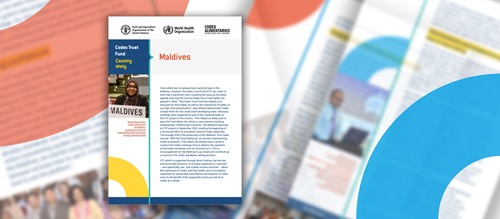
CTF / New success story from the Maldives shows a strengthened national food safety system
A new Success Story published by WHO and FAO demonstrates how support from the Codex Trust Fund (CTF) has helped the Maldives strengthen its national food safety system and improve its effective participation...
-jpg.tmb-thb5x4.jpeg?Culture=en&sfvrsn=73645107_1)
ACT / Cambodia Strengthens Capacity on Costing and Budgeting for its Multi Sectoral Action Plan on AMR
Siem Reap, Cambodia – 25 February 2025 The Food and Agriculture Organization of the United Nations (FAO), through the Action to support implementation of Codex AMR texts (ACT) project funded by the Ministry...