


Cambodia ups its Codex game
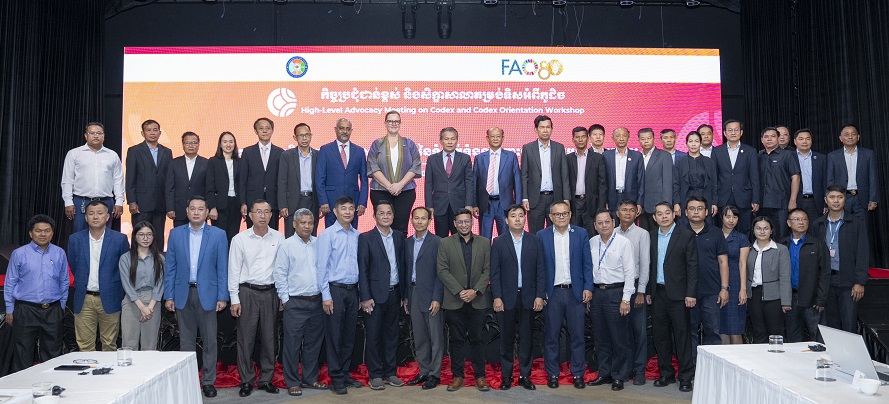
As an initial and strategic step to reinforce the national Codex programme in Cambodia — especially following the restructuring of competent authorities responsible for Codex — a High-Level Advocacy Meeting and a Codex Orientation Workshop were held in Phnom Penh from 27 to 29 May 2025 with the support of the Food and Agriculture Organization of the United Nations (FAO) Regional Office for Asia and the Pacific, and the Codex Trust Fund. These events were organized in collaboration with the Institute of Standards of Cambodia (ISC), Ministry of Industry, Science, Technology & Innovation (MISTI)
The event aimed to raise awareness among senior decision-makers and build national capacity to establish a well-functioning national Codex programme. It also sought to enhance Cambodia’s ability to participate effectively in Codex work and to identify appropriate mechanisms for coordination among relevant stakeholders. Participants included policymakers, technical officials, academic representatives, and members of both the public and private sectors.
The meeting was opened with welcome remarks from Ms Rebekah Bell, FAO Representative to Cambodia and followed by the opening remarks from H.E. KE Ky, Secretary of State, MISTI.
During the high-level meeting, Sridhar Dharmapuri, FAO Senior Food Safety and Nutrition Officer, highlighted the importance of Codex with a presentation on Codex and its links to relevant WTO agreements. These messages were further reinforced by Pisan Pongsapitch, a food safety expert, who shared Thailand’s experience with effective Codex participation and the resulting benefits.
At the orientation workshop, Panpilad Saikaew, project coordinator, FAO, gave an overview of the Codex Alimentarius Commission (CAC) and the process of elaborating Codex texts. She also introduced participants to the Codex website. Later, Pisan Pongsapitch discussed the key components of a national Codex programme, including the Codex Contact Point (CCP) and the National Codex Committee (NCC) or equivalent mechanisms. It was emphasized that, given limited national resources, Cambodia should prioritize its participation in Codex work based on national interests. Recommended priority topics were proposed for the establishment of sub-technical committees.
To enhance understanding of the structure and functions of a national Codex programme, group exercises were conducted on topics such as the roles and draft composition of the NCC and CCP, prioritization of Codex topics, and the formation of sub-technical committees.
Participants also received training on how to develop and present national positions on Codex issues. Additional group exercises focused on drafting procedures for developing national positions and submitting written comments.
Throughout the workshop, attendees engaged in discussions on the role of Codex in international trade, the importance of a well-functioning national Codex programme, how to actively engage in Codex work, and strategies to improve coordination among national stakeholders. They also reflected on the current challenges and progress Cambodia faces in its Codex participation.
This event marks a significant step toward strengthening Cambodia’s food safety system and its capacity to actively contribute to global Codex standard-setting processes.
© FAO / Panpilad Saikaew
Related content
Regional workshop equips countries to generate the science behind Codex pesticide MRLs
How can countries in Asia make sure their most important crops, especially tropical fruits and vegetables, are covered by Codex standards? That question drove a lively and highly interactive Regional Workshop...
Codex strategic plan takes centre stage at the 2026 Shenzhen Food Safety Forum
The 2026 Shenzhen Food Safety Forum took place in Shenzhen (China) on 15 September 2026 under the theme of “Sustainable Food Safety”, in response to the Codex Alimentarius Commission strategic plan 2026–2031...
Codex coordinators prepare for new regional meeting cycle, stress stronger coordination and capacity building
The Codex coordinators met with representatives of the Codex Secretariat, FAO and WHO, to prepare for a new cycle of FAO/WHO coordinating committee meetings, with six regional sessions scheduled between...
.tmb-thb5x4.jpeg?Culture=en&sfvrsn=33d295f8_1)
The 6th Global Conference on Foodborne AMR successfully held in Seoul, highlighting the achievements of the ACT Project
The 6th Global Conference on Foodborne Antimicrobial Resistance (GCFA) was successfully held on 13 May 2026 in Seoul, Republic of Korea. The conference has become an important international platform for...
ACT project to share experiences at the 6th Global Conference on Foodborne AMR
The FAO-implemented Action to support implementation of Codex AMR texts (ACT) project will share its experiences and challenges at the 6th Global Conference on Foodborne Antimicrobial Resistance (GCFA),...
.tmb-thb5x4.jpeg?Culture=en&sfvrsn=de5f6081_1)
ACT / Pakistan strengthens One Health response to foodborne antimicrobial resistance at national conference
Pakistan is stepping up efforts to address foodborne antimicrobial resistance (AMR), one of the most pressing threats to public health, food safety and sustainable agriculture, through a strengthened One...
CTF / New success story from the Maldives shows a strengthened national food safety system
A new Success Story published by WHO and FAO demonstrates how support from the Codex Trust Fund (CTF) has helped the Maldives strengthen its national food safety system and improve its effective participation...
-jpg.tmb-thb5x4.jpeg?Culture=en&sfvrsn=73645107_1)
ACT / Cambodia Strengthens Capacity on Costing and Budgeting for its Multi Sectoral Action Plan on AMR
Siem Reap, Cambodia – 25 February 2025 The Food and Agriculture Organization of the United Nations (FAO), through the Action to support implementation of Codex AMR texts (ACT) project funded by the Ministry...
-(cropped).tmb-thb5x4.jpeg?Culture=en&sfvrsn=7dba5d40_1)
ACT / Cambodia strengthens feed inspection capacity to combat antimicrobial resistance
Cambodia is stepping up efforts to curb antimicrobial resistance (AMR) in livestock production by improving the skills of its feed inspectors. From 3–5 December 2025, the Food and Agriculture Organization...